Dependency-light
Semantic HTML, modern CSS, and only the JavaScript that earns its place. No framework and no package-manager supply chain.
Flagship project · beta software
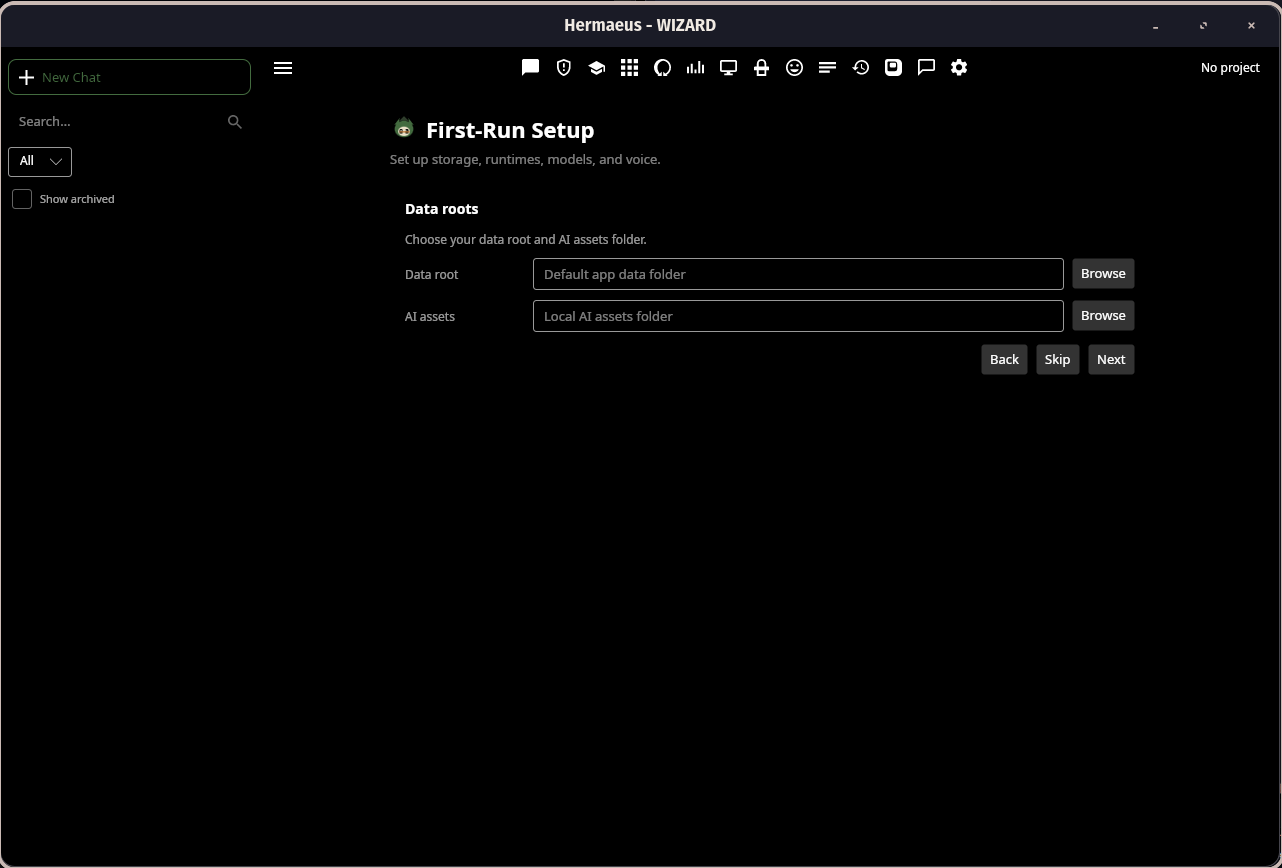
Hermaeus is a native, local-first AI workspace built to keep models, context, memory, agents, and runtime behaviour visible and under your control.
Selected work · Local AI
Hermaeus is the flagship. Around it, the work explores how local models run, retrieve, observe, and behave when the convenient abstractions are removed.
A Rust control plane for local model processes: lifecycle, resources, health, and controlled access.
A desktop studio for managing local voice-generation workflows without hand-wrangling the environment.
Local-first retrieval work that measures the machinery instead of merely wrapping it.
A controlled runner for studying what local models do in generated worlds when the answer is not quietly built into the environment.
Shared game technology
A reusable, game-agnostic .NET 10 runtime and deterministic content-generation stack. It grew out of Purrfect Chaos and became independent once Dungeon Dice provided a genuine second consumer.
Chaos owns reusable capability. Games own their characters, rules, catalogues, and world meaning.
See Dungeon Dice, the second consumerGame · Chaos System consumer
A mischievous cat sandbox born alongside Chaos System and now consuming its reusable runtime and generator. The game layer carries the island, characters, progression, and all the cat-specific meaning.
Chaos grew here. The cat game now consumes the shared layer while its world rules remain game-owned.
How the boundary worksGame · Chaos System consumer
A local-first fantasy RPG built on the shared stack: a persistent Living Tavern, recurring characters, generated spaces, and physical dice that resolve the next step of the adventure.
Dungeon Dice makes the Chaos boundary concrete: the shared layer provides capability, while the game owns the tavern, dice, characters, and meaning.
See the shared stackTools + experiments
Around the games sit mod management, system monitoring, desktop utilities, simulation, and experiments that started as questions worth following.
A native mod manager carrying the halted Linux effort forward with substantial Creation Engine support, plus Bannerlord 2, Cyberpunk 2077, and Stardew Valley support.
A native Rust dashboard for hardware health, thermals, diagnostics, and readable history.
Data-driven, multi-rate engine simulation with live diagnostics and a real audio handoff.
Extracts legally owned rhythm-game archives, converts charts and audio, and exports playable Clone Hero, YARG, or RB3 folders.
An SKSE-first framework for narrated Skyrim books.
Twelve Skyrim tavern NPCs whose conversations branch on player trust and intoxication, backed by a validated content pipeline.
Xbox 360 homebrew and console software research, focused on understanding controlled modification workflows.
About
Software engineering · systems · local AI · desktop · experimentation
I build software, break assumptions, and disappear down technical rabbit holes until something useful comes back out.
My work spans local AI, developer tooling, native desktop applications, systems engineering, graphics, and experimental projects. I tend to favour understanding and owning the important parts of a system instead of reaching for another dependency by default.
I care about software that can explain itself. Build it. Use it properly. Measure what happens. Find where the assumptions were wrong. Improve it. Repeat. If something only works in a demo, or cannot survive real use and a second look, it is not done.
I’m comfortable working where the abstractions stop being helpful: performance constraints, native runtimes, file formats, rendering, and model behaviour.
Engineering posture
Semantic HTML, modern CSS, and only the JavaScript that earns its place. No framework and no package-manager supply chain.
Fast, direct, and designed to get out of the way. The work should be doing the talking.
Keyboard-first navigation, strong focus states, reduced-motion support, semantic structure, and resilient responsive layouts.